Walk into any real estate office in Hyderabad and you’ll see two types of projects. One shows massive towers – maybe 2000 flats packed together. Another shows low-rise buildings – just 100 units spread across an acre. Both are selling homes. Which one should you buy? Let’s talk high-density living vs low-density living without the sales pitch.
What These Numbers Actually Mean
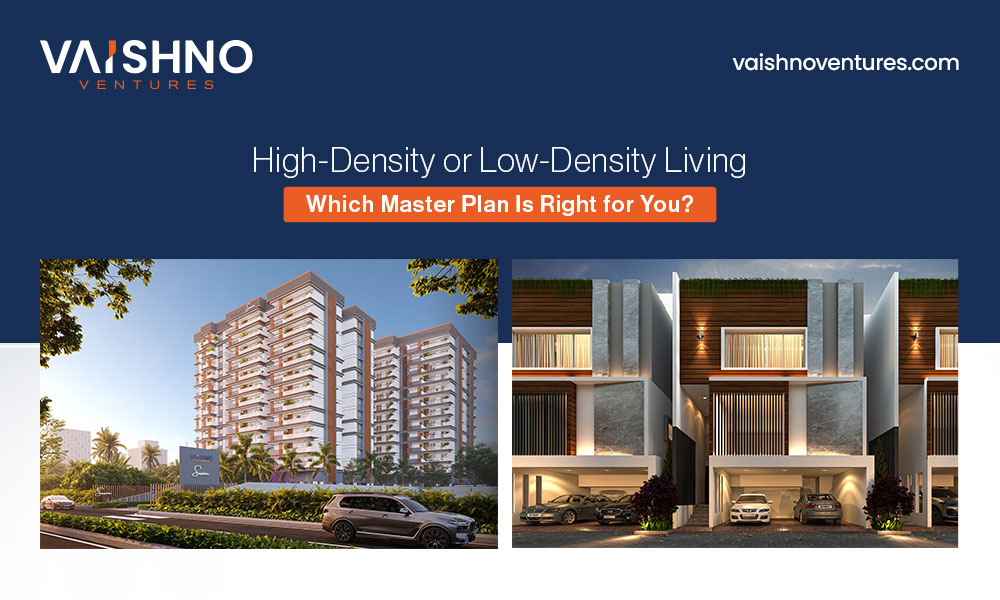
2000 flats in one complex means serious crowding. Think 10-12 towers, each 20-25 floors high, standing close to each other. Every inch of land has either a building or parking on it. Some amenities squeezed wherever space allows.
100 units per acre is the opposite. Low buildings, maybe 4-6 floors. Lots of open ground between them. Trees, gardens, walking space. It’s not about fancy amenities – it’s about having room to breathe.
The lifestyle difference is massive.
Why People Buy in 2000 Flat Complexes
First, let’s be honest about why high-density residential living sells.
The amenities list looks amazing. Big clubhouse, large pool, multiple gyms, sports courts. When 2000 families are paying, builders can afford impressive facilities.
Maintenance gets divided among many people. Your share might be just 2,500 rupees monthly because costs are split 2000 ways.
These places become famous. Everyone knows “XYZ Towers with 2000 flats.” Easy to give directions. Easier to resell later because people recognize the name.
Kids will definitely find friends. With 2000 families, there are plenty of children around. Adults find their social circles too.
What Living in 2000 Flats Actually Feels Like
Now the reality nobody mentions clearly.
Lifts are daily torture. Morning 8 AM, everyone going to office. You wait, wait, wait. Lift finally comes, already full. Can’t fit. Next one. You’ve wasted 10-15 minutes just getting down from your flat.
Same thing evening. When a lift breaks – which happens often with heavy usage – it becomes complete nightmare.
Parking is constant headache. 2000 flats means 2500-3000 vehicles minimum. Finding your car takes time. Coming home late? No parking available. Guests? They park outside on street.
People fight about parking every single day. Someone in your spot. Someone blocking your exit. Never-ending drama.
That impressive swimming pool? Saturday morning has 60-70 kids crammed in it. Can’t swim properly, just standing in water crowd. Gym equipment has queues during evening. Badminton court booking needs advance planning.
Privacy is gone. Your balcony faces 25 other balconies. Everyone can see into your flat. You hear neighbors’ arguments, TV sounds, crying babies from multiple directions. Keep curtains closed for privacy? Now flat stays dark.
Gate entry wastes time. One entrance for 2000 families. Morning and evening rush creates long lines. Every delivery, every visitor, every maid – all waiting at gate.
You don’t know anyone really. Too many people to build actual relationships. In emergency – medical issue, need quick help – you don’t even know who to ask.
Getting anything done through RWA is impossible. Try getting 2000 families to agree on anything. Meetings are chaos. Simple decisions take months, getting work done takes years.
Noise never stops. With 2000 families, someone’s always doing something – party, renovation, argument. Constant background noise becomes your life.
The whole place feels like corporate office campus. Numbered buildings, numbered parking, numbered everything. No warmth. Just residential factory storing people.
What 100 Units Per Acre Gives You
Low-density residential living is completely different experience.
Actual open space exists. Not just shown in brochure. Real grass where kids play. Real trees giving shade. Paths where you can walk without dodging crowds constantly.
Sit on your balcony and see greenery instead of another concrete tower 20 feet away.
You get real privacy. Buildings have distance between them. Your life isn’t on display for 30 neighboring balconies. Open your windows without feeling everyone’s watching.
Noise from neighbors is minimal because you don’t have 15 flats surrounding yours from every side.
Amenities are actually comfortable to use. Pool with 100 families means maximum 15-20 people on busy day. You can genuinely swim. Gym has 3-4 people, equipment available when you want. Play area isn’t overrun with 40 kids.
Lifts work like lifts should. Press button, lift comes in 2 minutes. No crowds, no waiting forever. This one thing alone improves daily life quality significantly.
Parking is straightforward. 100 units means maybe 130-140 vehicles. Your spot is easy to find. Guest parking usually available. No daily fights.
Community feeling is real. 100 families is manageable. You know many neighbors, not just faces. Kids know each other. People help genuinely because actual relationships exist.
Medical emergency? Neighbors respond because they know you. Going away? Someone waters plants because you have real connections.
Air flows properly. Low buildings don’t trap everything. Ground floor still gets sunlight because no giant tower blocking it completely.
RWA meetings have 30-35 people. Decisions can happen. Want to improve something? Actually possible to get agreement and make it happen.
It feels like neighborhood, not institutional complex. Kids can cycle around safely. Elderly can walk comfortably without being overwhelmed.
What Low-Density Costs You
Nothing is free. Low-density has real downsides.
Maintenance costs more per family. Same expenses divided by 100 instead of 2000. You might pay 5,000-6,000 monthly instead of 2,500.
That’s 30,000-36,000 extra per year. Over 10 years, that’s 3-3.6 lakhs more. Real money.
Fewer fancy amenities sometimes. Builder might skip the mini theatre or huge clubhouse because not enough people to justify cost.
Less social buzz. If you like constant activities and events, low-density might feel too quiet.
Takes longer to sell sometimes. Smaller complexes aren’t as well-known. Finding buyers needs more effort.
Usually located further out. Central expensive areas only have high-density projects because land costs too much for low-density to make sense.
Who Fits Where
2000 flat high-density works if:
- You leave at 7 AM, return 10 PM, miss all peak time chaos
- Maintenance budget is really tight
- You actually prefer anonymity, don’t want close neighbors
- Your personality handles crowds and waiting fine
- Kids need maximum options for friends
- Location is more important than daily comfort
100 units per acre low-density suits:
- You work from home or are around during day
- Crowds and waiting genuinely frustrate you
- You value using amenities over just having them listed
- You want to know neighbors and have community
- You can manage higher maintenance cost
- Peaceful living matters more than lower bills
- Elderly parents live with you who need quiet
Do the Real Math
Low-density costs 2,500 more monthly. That’s 30,000 per year, 3 lakhs over 10 years.
What does that 3 lakhs buy you?
- No lift frustration daily – saves probably 20 minutes per day
- Comfortable amenity usage
- Peace and quiet at home
- No parking fights
- Helpful neighbors when needed
Worth it? Depends completely on you. Some people absolutely yes. Others would rather keep that 3 lakhs.
Actually Visit Both Types
Go to a big 2000 flat complex on weekday morning at 8 AM. Watch lift situation for 15 minutes. See parking chaos. Visit pool on Saturday afternoon. Ask residents what annoys them daily.
Then visit low-density complex same times. Experience the difference yourself. Reading about it is one thing, seeing it tells you what you’ll actually tolerate living with.
What Matters Over 10 Years
You’re living here for 10-15 years minimum. Daily annoyances compound.
Frustrated about lifts and parking every day for 3650 days? That wears you down. Is saving some maintenance money worth years of daily irritation?
Or spending extra 3 lakhs over decade for peaceful, comfortable living without constant frustrations? Is that worth it for your mental peace?
High-density living vs low-density living is completely personal. No universal right answer. Depends on your specific life, personality, what frustrates you, what you value.
Stop Choosing Backwards
Most people pick based on location and flat cost, then just live with whatever density that complex has. Wrong approach.
Density affects daily happiness more than people realize. Give it serious thought.
High-density residential living with 2000 flats can work if you genuinely don’t mind crowds, noise, waiting, anonymity. Some personalities are fine with it. They prioritize other things like location or lower costs.
Low-density residential living with 100 units per acre gives far better daily life quality if you value space, quiet, community, comfort. But definitely costs more.
The benefits of high-density living and benefits of low-density living are both real. Question is which benefits matter to YOUR actual life and personality.
Choose based on honest understanding of yourself – what actually matters to you for comfortable daily living over next 10 years. Not what sounds good. Not what friend recommends. What fits YOUR life specifically.
Your money, your home, your daily experience. Make the choice that fits you, not the choice that fits someone else’s priorities.
Frequently Asked Questions (FAQs)
What is considered high-density residential living?
High-density residential living typically refers to housing projects with a large number of apartments within a limited land area—often 1,500 to 2,500+ units in a single gated complex. These projects usually have high-rise towers, shared amenities, and higher population concentration.
What does low-density residential living mean?
Low-density living refers to residential developments with fewer homes per acre—usually around 80–120 units. These projects feature low-rise buildings, more open spaces, better airflow, and a quieter, less crowded living environment.
How does density impact daily lifestyle?
Density directly affects daily comfort. High-density projects often involve longer lift waiting times, crowded amenities, parking challenges, and more noise. Low-density communities generally offer easier movement, better privacy, quieter surroundings, and more relaxed use of shared spaces.
Are maintenance costs lower in high-density apartments?
Yes. In high-density projects, maintenance expenses are divided among a larger number of residents, which often results in lower monthly maintenance charges per apartment compared to low-density developments.
Why is maintenance higher in low-density communities?
In low-density communities, the same infrastructure and operational costs are shared by fewer households. This results in higher per-unit maintenance, although residents typically receive better comfort, less crowding, and higher quality daily living.