Talk to five people who moved from a house into an apartment and at least three will bring up the garden. Not the parking, not the lift, the garden. Something about not having a patch of green outside your own door changes how a place feels, even if the flat itself is bigger than the house was.
That’s usually just accepted as part of the deal in most Indian cities. Hyderabad too.
But it’s shifting. Quite a few of the newer luxury apartments coming up in Kollur are being planned with the outdoors built in from the start, not bolted on later. Vaishno Sapphire falls into that bucket.
Before assuming apartment living is automatically indoor and boxed-in, worth pointing out that outdoor amenities have gone from optional extra to actual deciding factor for a lot of buyers now.
Why Open Space Has Become a Real Priority for Buyers
Ask someone who grew up in an independent house what they miss in a flat. Rarely the size of the rooms. Usually it’s simpler than that, being able to walk outside without immediately being on a road.
That’s the gap driving demand for open space apartments in Kollur. Not that long ago, “amenities” meant a basement gym and a hall that got used twice a year for weddings. Buyers expect more now: walking paths that are actually landscaped, real green cover, a play area for kids that isn’t secretly a car park by Saturday afternoon, enough gap between the towers that the whole complex doesn’t feel like it’s leaning on you.
And this shows up in ways beyond just personal preference. Brokers mention it during resale conversations. It comes up when comparing rental listings. More than one family has told me — well, told developers, anyway — that this single factor decided between two projects that looked identical on paper.
What “Premium Outdoor Amenities” Actually Looks Like
Everyone uses the phrase. Fewer people can define it once you push past the brochure copy.
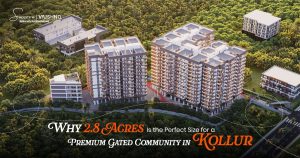
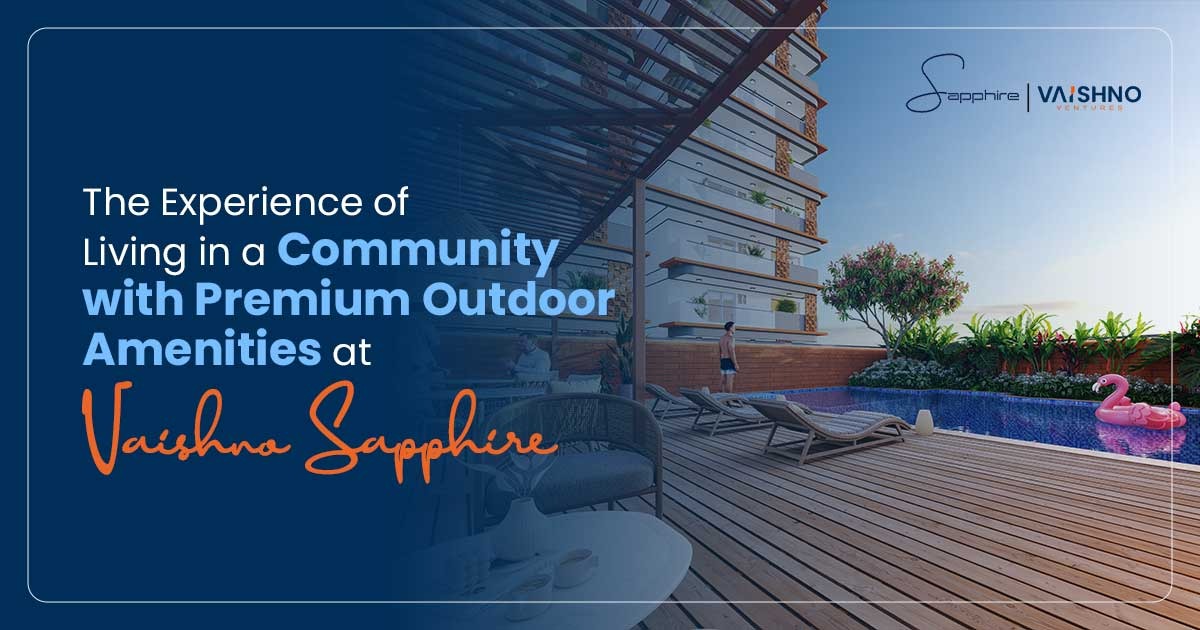
Landscaped, walkable green space is the obvious one. Not a strip of grass by the gate for photos, but paths built for an actual morning walk, or somewhere to sit outside with a book in the evening. Vaishno Sapphire’s 2.8-acre layout has room for this partly because there are only two towers here, around 276 units total, not eight towers stacked on the same plot.
Dedicated outdoor recreation space matters too. Jogging tracks. Lawns big enough for kids to genuinely run around, not a fenced-off corner between parked cars. Seating that someone actually thought about, rather than a bench dropped in as an afterthought.
Density is the part people skip past, and it’s probably the most important one. Fewer towers on the same land means more open ground between the buildings. That’s not really a design choice worth debating, it’s just how the math works out. Less concrete, more open ground per resident.
Then there’s the everyday test: do the amenities actually feel usable, or is everything a queue? A pool you can swim laps in without waiting behind a dozen other families. A bench in the garden that’s free more often than not.
Why This Matters More in Kollur Specifically
Location plays a bigger part in this than most people give it credit for.
Kollur is still fairly open as far as West Hyderabad goes. It hasn’t been built up wall-to-wall with towers the way some of the older IT corridors have. That gives developers genuine room to plan around outdoor space instead of squeezing it into whatever space is left over.. It’s a big reason premium residential projects in Kollur have leaned into open-air amenities the way they have.
Then factor in connectivity. Decent access to the Outer Ring Road. A manageable distance to the Financial District, Gachibowli, Neopolis. Put those two things side by side and you get something not easy to find elsewhere in the city at a similar price — close enough to major job hubs for a commute that doesn’t wreck your evening, but still spacious enough that a project can genuinely offer green, open living rather than just claiming to.
The Everyday Experience: What Living Here Actually Feels Like
Floor plans and brochures only tell part of the story. The real difference is in the small, boring parts of an ordinary day.
Walking in the morning without dodging traffic. Letting the kids cycle without watching every car that turns the corner. Spending an evening outside instead of on a screen, because there’s finally somewhere decent to sit. A Saturday morning where the garden isn’t crowded, mostly because the community itself isn’t.
There’s a quieter thing too that doesn’t get talked about much. Call it mental space, for lack of a better phrase. Apartment living can start feeling closed-in fairly fast, particularly for anyone used to more room growing up. Having genuine outdoor space inside the gate, not a drive away, changes that daily rhythm in a way that’s hard to put a number on but pretty obvious once you’re actually living it.
Families with young kids tend to weigh this heavier than square footage inside the flat. Working professionals feel it differently — five minutes to decompress after work outside versus getting back in the car to go find some open space somewhere else.
The Investment Angle: Do Outdoor Amenities Actually Add Value?
Short version: yes. Just maybe not the way most people assume.
Outdoor amenities aren’t only about making a home nicer to live in day to day. They shape how a project gets perceived years down the line, and that matters a lot come resale time. A community with real open space and gardens that someone’s actually maintaining tends to age better, both how it looks and how it functions, compared to one where every inch got built over.
Rental demand ties into this too. Tenants, especially working professionals relocating for IT jobs, increasingly weigh outdoor and recreational space alongside the interior specs, not instead of them. A project that gets this right tends to hold rental interest more consistently.
And low-density layouts aren’t something you can retrofit later. A project either had the land to spare for open space when it went up, or it didn’t. That scarcity is part of what gives early buyers in a corridor like Kollur a longer runway of advantage.
What to Look for When Evaluating Outdoor Amenities in a Project
A handful of things worth checking directly instead of trusting the amenity list on a website.
Actual green cover against paved area, best confirmed from the layout plan itself. Distance between towers, since that decides how open a project actually feels day to day far more than the amenity count does. Whether the amenities are shared across the whole project or just your block or phase. Who’s responsible for landscaping maintenance long-term, because gardens that look great at launch and get neglected within two years aren’t much of an asset. And resident count against amenity capacity, since that ratio is what actually decides whether you use these spaces or just walk past them on the way to your car.
Final Thoughts
Outdoor amenities used to be an afterthought, something squeezed in once the towers were basically done. That’s changing, and Kollur happens to be one of the places where it’s changing faster than most. Quieter mornings. A safer spot for kids to play. Just more room to breathe than the average high-rise offers. Whatever it is you’re after, the move toward genuine open-space living in projects like Vaishno Sapphire is worth paying attention to. It isn’t only about what’s inside the flat anymore. What’s right outside your door matters just as much.
Quick Answers
Q1: Why are outdoor amenities becoming a priority for apartment buyers? Buyers want more than four walls and a lift these days. Landscaped walking paths, open lawns, real green space. It’s the thing independent-house living used to offer that apartments usually didn’t: room to step outside without stepping onto a road.
Q2: What counts as a “premium outdoor amenity” in a residential project? More than a token patch of grass, generally. Proper walking or jogging tracks, open lawns for recreation, gardens that are actually maintained, and enough distance between towers so outdoor spaces don’t feel cramped or fought over.
Q3: Does a low-density layout actually mean more outdoor space? Yes, and it’s one of the more direct relationships in residential design. Fewer towers on the same land parcel leaves more open ground between buildings. More open ground usually means more usable outdoor area per resident.
Q4: Why is Kollur well suited to open-space residential projects? Kollur is still fairly open compared to some of the denser parts of West Hyderabad, which gives developers more room to design around green space. Add its connectivity to the Financial District and Gachibowli, and it’s a fairly rare mix of access and openness.
Q5: Do outdoor amenities affect a property’s resale or rental value? They can. Communities with real, well-kept open space tend to age better both visually and functionally, and increasingly factor into how tenants and resale buyers compare projects, not just the interiors.
Q6: What should buyers verify before trusting a project’s outdoor amenities claims? Ask for the actual site layout plan instead of relying on the amenities list alone. Check the distance between towers. Confirm whether amenities are shared across the full project. And ask directly about long-term landscaping upkeep.
Q7: Are outdoor amenities more important for families with children? Often, yes. Safe open spaces for kids to play and cycle without traffic exposure become a daily consideration rather than an occasional luxury, and can end up mattering as much as square footage inside the flat.
What Makes Vaishno Sapphire Stand Out?
- Project: Vaishno Sapphire is a residential development in Kollur, Hyderabad, spread across 2.8 acres.
- Layout: Comprises two towers (G+12) with approximately 276 units, leaving comparatively more open ground for landscaping and outdoor amenities than higher-density projects on similar land parcels.
- Configuration: Offers 2 and 3 BHK apartments suited to families, professionals, and investors seeking a low-density, outdoor-oriented lifestyle.
- Connectivity: Positioned with access to the Outer Ring Road (ORR) and reasonable proximity to the Financial District, Gachibowli, and Neopolis.
- Outdoor focus: The project’s low tower count relative to land area supports genuine open-space amenities, distinct from projects where land is maximized primarily for built-up area.
- Market context: Located within Kollur, a West Hyderabad corridor still in a comparatively open development stage, allowing more room for outdoor-focused residential design.
Frequently Asked Questions (FAQs)
What kind of outdoor amenities does Vaishno Sapphire offer?
Vaishno Sapphire’s low-density layout across 2.8 acres, with only two towers, is designed to accommodate landscaped open spaces and outdoor recreation areas as part of its overall community design.
How does tower density affect outdoor amenity space?
Fewer towers on a given land parcel generally leave more open ground for gardens, walking paths, and recreational areas, compared to projects that maximize built-up area across multiple towers.
Is Kollur a good location for projects with open-space amenities?
Kollur’s relatively open development stage within West Hyderabad gives developers more flexibility to design around green space, compared to more densely built established corridors.
What should I look for in a project's outdoor amenities before buying?
Review the actual site layout plan, the distance between towers, whether amenities are shared community-wide, and the developer’s landscaping maintenance approach.
Do outdoor amenities increase a property's long-term value?
Well-maintained outdoor spaces can positively influence how a project is perceived over time, which may support resale and rental appeal, alongside other factors like location and build quality.
Are premium apartments in Kollur suitable for families with young children?
Families often prioritize projects with safe outdoor play areas and open spaces, making location and amenity design important considerations alongside interior configuration.
What is considered a low-density residential project?
A low-density project typically refers to a development with a comparatively lower number of units relative to its land area, resulting in more open space and lower resident density per acre.
How does Kollur compare to Gachibowli in terms of open space availability?
Kollur is generally less densely developed than more established corridors like Gachibowli, which can allow for more spacious project layouts, though both offer proximity to key IT and business hubs.
Are gated communities with outdoor amenities more expensive?
Pricing varies by project, but developments offering genuine low-density layouts and outdoor amenities may be positioned at a premium compared to high-density alternatives, reflecting the additional land allocation involved.
What role does landscaping maintenance play in outdoor amenities?
Ongoing landscaping maintenance determines whether outdoor amenities remain usable and visually appealing over time, making it an important factor for buyers to confirm before purchase.
Can outdoor amenities affect rental demand?
Yes, tenants — particularly working professionals — increasingly consider outdoor and recreational amenities when comparing rental options, alongside interior specifications and location.
How many units does Vaishno Sapphire have?
Vaishno Sapphire comprises approximately 276 units across two G+12 towers on a 2.8-acre site in Kollur.
What configurations are available at Vaishno Sapphire?What configurations are available at Vaishno Sapphire?
The project offers 2 BHK and 3 BHK premium apartments.
Why do open-space apartments in Kollur appeal to IT professionals?
Open-space apartments offer a lifestyle balance — proximity to IT hubs like the Financial District and Gachibowli combined with a less congested, more livable residential environment.
Is proximity to ORR important for residential projects in Kollur?
Yes, access to the Outer Ring Road significantly improves connectivity to other parts of Hyderabad, making it an important factor for residents commuting to employment hubs across the city.